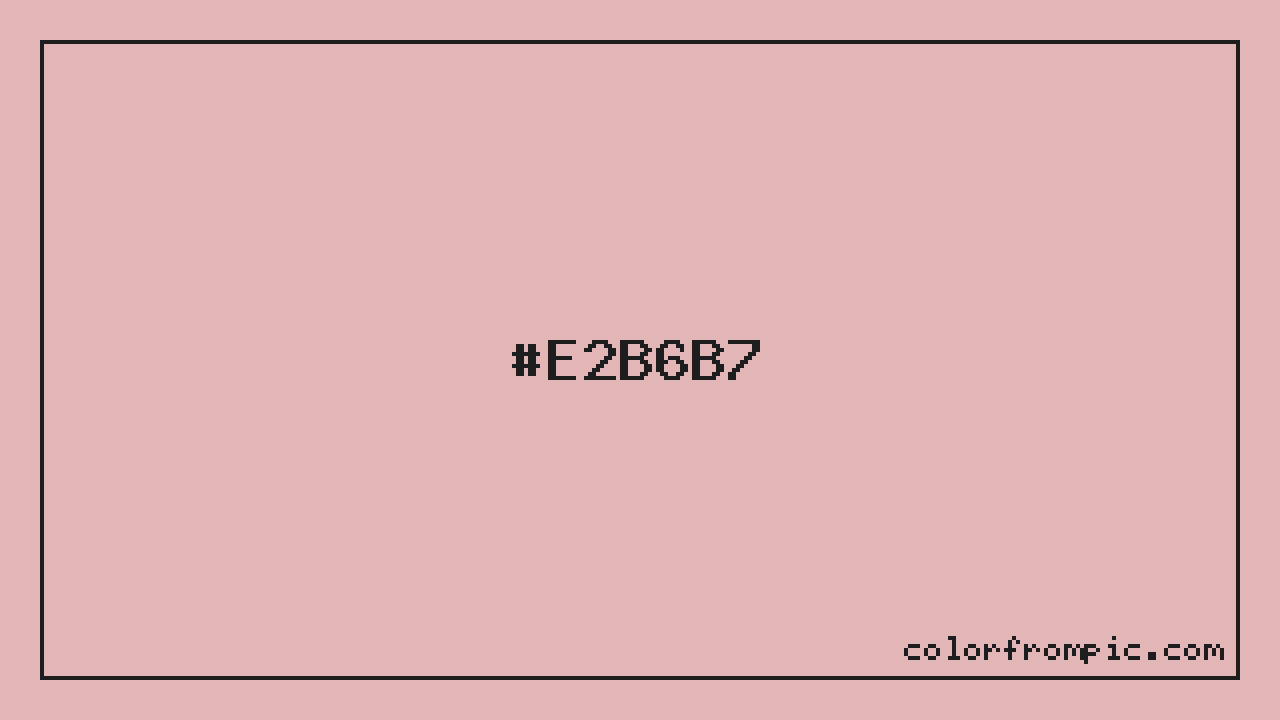
The hexadecimal color code #E2B6B7 represents a light shade in the red family. In the RGB color model, this color is composed of 226 red, 182 green, and 183 blue, which translates to approximately 89% red, 71% green, and 72% blue. This makes it a slightly desaturated color with warm undertones that can evoke different emotional responses depending on its application.
When analyzed in the HSL (Hue, Saturation, Lightness) color space, #E2B6B7 has a hue of 359 degrees, a saturation level of 43%, and a lightness value of 80%. The hue angle of 359° places this color firmly in the red spectrum. In the HSV/HSB color model, this translates to a hue of 359°, saturation of 19%, and brightness/value of 89%.
For print applications using the CMYK color model, #E2B6B7 would be reproduced using 0% cyan, 19% magenta, 19% yellow, and 11% black. The closest web-safe color is #CCCCCC, which may be useful for ensuring compatibility across older displays and systems.
This color works well in various design contexts. As a lighter shade, it's excellent for backgrounds, negative space, and creating a sense of openness in designs. The moderate to low saturation gives this color a sophisticated, muted quality that works well in professional and minimalist designs. When pairing #E2B6B7 with other colors, consider its complementary color at hue 179° for maximum contrast, or use analogous colors within 30° of its hue for harmonious combinations. The decimal representation of this color is 14857911, which can be useful in certain programming contexts.
🔢 Color Conversion Codes for #E2B6B7
Tailwind CSS
rose-300
HEX
#E2B6B7
RGB
rgb(226, 182, 183)
RGB %
89%, 71%, 72%
HSL
hsl(359, 43%, 80%)
HSV
hsv(359, 19%, 89%)
CMYK
0%, 19%, 19%, 11%
Decimal
14857911
Web Safe
#CCCCCC
🎨 Color Schemes for #E2B6B7
Complementary
Analogous
Triadic
Split Complementary
Tetradic (Rectangle)
🔄 Alternatives to #E2B6B7
🌗 Shades and Tints of #E2B6B7
Shades (adding black)
Tints (adding white)
🎚️ Tones of #E2B6B7
Tones (adding gray / desaturating)
🌈 Hue Variations of #E2B6B7
Hue Variations (shifting the color spectrum)
👁️ Preview of #E2B6B7 in Use
Text on #E2B6B7
This demonstrates text readability on the color background. (Click to edit)
#E2B6B7 as Text
This shows the color used as text on white. (Click to edit)
👓 Color Blindness Simulation for #E2B6B7
Check how a color is perceived by people with different types of color blindness to create more accessible designs. Understanding color perception helps ensure your content is accessible to everyone.
Light Rose is a light, moderately saturated, warm red color with a hue angle of 359°, saturation of 43%, and lightness of 80%. Its RGB value is (226, 182, 183) and its CMYK breakdown is C:0% M:19% Y:19% K:11%.
This is a Summer (Light) color palette archetype. Compassion, Playfulness, Romance. Pink is intuitive and insightful, showing tenderness and kindness.
Frequently Asked Questions About #E2B6B7
What is the HEX code for Light Rose? +
The HEX code for Light Rose is #E2B6B7. In CSS you can use it directly as color: #E2B6B7; or as a background: background-color: #E2B6B7;. The three-character shorthand is not available for this color since it cannot be reduced without changing the value. Use the full six-character hex for accurate reproduction in any web or design project.
What is the RGB value of #E2B6B7? +
The RGB value of #E2B6B7 is rgb(226, 182, 183). This means the color contains 226 out of 255 parts red, 182 out of 255 parts green, and 183 out of 255 parts blue. Red is the strongest channel in this color mix. You can use the full RGB function in any CSS property: color: rgb(226, 182, 183);
What is the HSL value of #E2B6B7? +
The HSL value of #E2B6B7 is hsl(359, 43%, 80%). The hue is 359°, placing it in the red family on the color wheel. The saturation is 43%, making it moderately saturated. The lightness is 80%, making it light. HSL is the most useful format for programmatic color manipulation in CSS, as you can easily adjust lightness to create tints and shades.
Is #E2B6B7 a warm or cool color? +
#E2B6B7 is classified as a warm color based on its hue angle of 359°. Warm colors — reds, oranges, and yellows — evoke energy, enthusiasm, and urgency. They tend to advance visually and draw the eye. In design, warm colors are often used for calls-to-action, food and hospitality brands, and anywhere a feeling of warmth or excitement is desired.
What is the CMYK value of #E2B6B7? +
The approximate CMYK value of #E2B6B7 is C:0% M:19% Y:19% K:11%. CMYK (Cyan, Magenta, Yellow, Key/Black) is the color model used in physical printing. Unlike RGB which mixes light additively on screens, CMYK mixes inks subtractively on paper. Note that the RGB-to-CMYK conversion is an approximation — screen colors and print colors exist in different color gamuts, and some screen colors cannot be exactly reproduced in print. For precise print work, consult a professional print color profile or Pantone matching system.